
A tradition in stone
As ancient as Hinduism is the art of temple building. Many materials have been used in temple building. One thousand three hundred years ago, the Pallava kings of south India pioneered building temples in granite. The Chola kings and the Vijayanagara rulers who came after them built on their expertise, and temple building in granite reached its pinnacle. One need look no further than the architectural marvel of the grand Bṛhadeeswarar Temple in Thanjavur.
That it has withstood the onslaught of invaders and the elements for a thousand years is a testimony not only to the extraordinary Tamil king Raja Raja Cholan’s vision but also to the strength of the granite used in its construction. Granite is an age-defying stone of unique strength. That is why our ancestors chose this wonderful stone for building the House of Gods. To this day no one knows where the great Raja Raja Cholan obtained his granite; all that is said is speculation.
The oldest agamic temple, and the only Ganesh temple, in Victoria was going to be embellished. Following the tradition of the Pallavas, Cholas and Vijayanagaras, the Melbourne Vinayagar Hindu Sangam decided to transform its temple in granite. The person blessed to be chosen for the task of granitization (if one can say that) of the temple was the Sthapati (temple architect and builder) Mr Purushothaman. He had the privilege of building the first abode in 1992, and had now been recalled for the third time by Sri Vakrathunda Vinayagar to transform all shrines into granite. This is a historic event as far as Hinduism in Australia is concerned. We spoke to the Sthapati Mr Purushothaman for some interesting insights into temple building and granite.
Finding the granite
He was very emotional while recounting his experiences starting from the time he received this divine assignment in November 2018. He immediately left for India on the mission of procuring the granite. Purushothaman had conceived and drawn the architectural design, and the granite would be cut and sculpted there to match it.
The granite pieces would arrive here ready, in a sense, to be assembled. He spent a year in south India, leaving his family behind, totally immersing himself in the mission of this granite transformation of Sri Vakrathunda Vinayagar Temple. He proudly proclaimed that it was the grace of Sri Vakrathunda Vinayagar that he completed in one year what would normally have taken five. Most of the temple reconstruction was going to be within the existing structure. They had applied for approval of a height of ten metres. Purushothaman had designed the Moolasthanam envisaging sixteen Ganapathy statues all around. He also planned decorative elephants all around culminating in a Rishabakunjaram: a bull and an elephant sharing one head, a visual illusion in the Chola style.
He went to Kanchipuram and began work on granite there, but it seemed to develop cracks and was abandoned. Meanwhile, the height approved came in at less than ten metres. He had already redrawn his designs several times to meet the changing needs of the Sangam; this was the last time he had to redraw them. Purushothaman now had the tedious task of finding granite as the Moolasthaanam alone would require over 270 tonnes of granite. He found a supply of granite, but after some progress realised that all the granite needed for Sri Vakrathunda Vinayagar Temple could not be sourced from the same rock. Following the great tradition of the ancient granite temples, Purushothaman wished to have all the granite carved out of the same mountain.
Scouting further, he came upon a place called Raasipuram in Naamakkal in south India. Naamakkal, by the way, is famous for its gigantic Hanuman statue. Perhaps, since Hanuman is also present here at Sri Vakrathunda Vinayagar Temple, he too helped in Purushothaman’s mission of finding granite from a single source. Once the granite was found, a sample was sent to IIT Madras and expensive tests were carried out to certify it safe against earthquakes. He then set up three different sites to carry out the work with six-day weeks and pushed hard to meet the deadline. All the granite was transported to Mamallapuram and 60 traditional temple sculptors worked tirelessly on this project. The tempo continued and ten shipments of cut and carved granite shrines arrived in Melbourne. Purushothaman would have liked to be in India and Australia at the same time, had it been possible.
Why granite
Asked what is so special about granite, Purushothaman explained further. Stone hardness is measured by a scale called “Mohs”. The student of stone carving begins with soapstone, with a Mohs hardness of 2, which makes it easy to work. Limestone and sandstone, with a Mohs hardness of 4, twice as hard as alabaster, are good for carving. However, our ancient shilpis chose granite, with a Mohs hardness of 8, even though it is extremely difficult to chisel. Granite was deemed the ideal stone for temple building. It is the hardest and most durable stone found in India.
Sculpting temples in granite became a fine art. The artisans could carve trellises so fine that people mistook them for metal grilles, as in the Bṛhadeeswarar Temple. Temples made of granite have lasted for thousands of years. Granite is a stone that has the five elements in the optimal proportion. It has a degree of moisture and warmth built in. It is the ideal stone to absorb the divine vibrations in the form of mantras from air and water and so it is used for the moola murthy (the presiding deity). Choosing granite for the deities has its intricacies, such as choosing the granite suited to each gender.
Granite stones for temple building must be of the correct tone and quality. It is an extremely tough stone. But if it is too hard, it cannot be chiselled and shaped as the temple needs. And even with the right quality found, a huge amount of granite was required since in addition to the sanctum sanctorum (moolasthaanam), ten other shrines had to be built. The statues on top of the moolasthaanam and all other parivara shrines including vimanas were also being transformed into granite.
The science of temple building
Talking about temple building, he explained many technical terms. Vaastu sastra has been trivialised these days, with many thinking it is just a matter of calling a Vaastu man and asking where the kitchen should go. Vaastu sastra is the science inherited from ancient Shilpa rishis to design spatial forms in art and architecture using a framework of time and space units. This traditional Hindu architecture aims to construct spaces that live in harmony with the gross as well as the subtle nature. Incorporating this harmony with the cosmic spirit is called Vaastu dharma.
Sthaapana (establishment) of spiritual abodes is explained in the staapatya veda. Curiously, vinn (space), once enclosed, becomes a living organism and gives rise to living beings. Like the human body, a building also encloses vinn (space) and vibrates in a particular order or rhythm. The two are modulated to resonate with each other and generate spiritual well-being and peace. Achieving this synchronisation with the universal vibration is the Vaastu rahasya (secret of Vaastu).
The unit of measurement in this science is the thaala, as in music and dance, since the Vaastu Veda says time and space equate to measure and form. Thus a sthapati can be said to create musical compositions, which transform into the temple. At this point, one would wonder about Rajaraja Chola’s sthapati. The symphony of the great Bṛhadeeswarar Temple was composed by the esteemed sthapati Kunjaara mallan Rajaraja Thachchan. The word thachchan means a sort of creator. Viswakarma was the Deva Thacchan who designed the universe. To date, no one has cracked the code of sthapati Kunjaara Mallan’s magnificent Vimaanam rising into the sky for two hundred and twenty-one feet and six inches all in granite.
Temple building is explained in our sastras. Apparently, there are more than 28 Shilpa sastra treatises in Sanskrit, such as Maya matham, Kaasiyapam, Vishwa karmiyam, Maanasaaram, Ainthira matham, Manusaaram, Braahmiyam, and Sakalaathikaaram. These have been translated into Tamil and collated for the use of all sthapatis. They provide the complete information and expertise needed to construct a Hindu temple. From choosing the land to build on to the smallest dimensions, everything is explained meticulously.
The Kaasiyapa Shilpa sastra refers to the temple as Prasaadam, Mantram, Aasreyam, Aadharam, Divya-vimaanam, Pradhishniyam and so on. Temples come into being in several ways: in some places the Almighty appears as suyambu (self-created); in others, to grant boons to rishis; and elsewhere kings and the righteous, following the path of dharma, built temples. Just as the soul is housed in the body, the Almighty is present in the temple. The power of the universe may be present everywhere but the Almighty is especially present in the temple to grant grace to humanity. Temples are not just prayer halls; they house the para-thathuva of Brahmam (supreme reality). Then it dawned on humanity that this brahmam is the power that is present in all beings. This great truth is the basis for the creation of Hindu temples.
Purushothaman also explained that in the analogy of the universe as the Viraata purusa, the Sun is the brain, the temple is Shivam and the dharmic nature of devotees is Shakthi. The Sarva gnanothara aagama states that the Gopura is Boothaatma, Palipeeda is Antharaatma, Dwajastamba is Thathvaatma, Shivalingam is Jeevaatma, Guru is Mantraatma and Brahmaranthiram is Paramaatma.
The temple as the human body
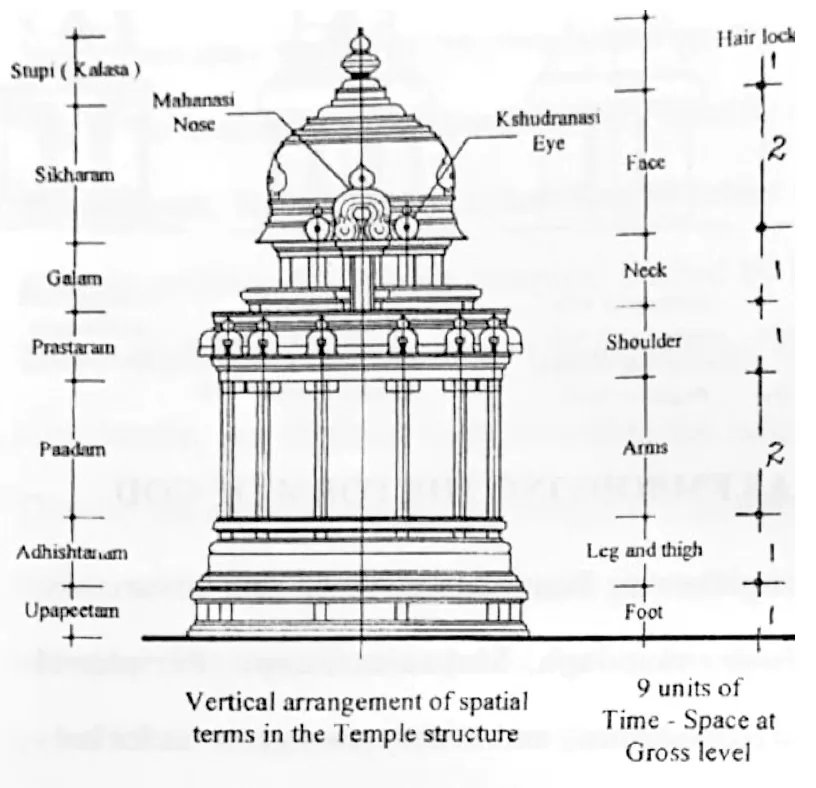
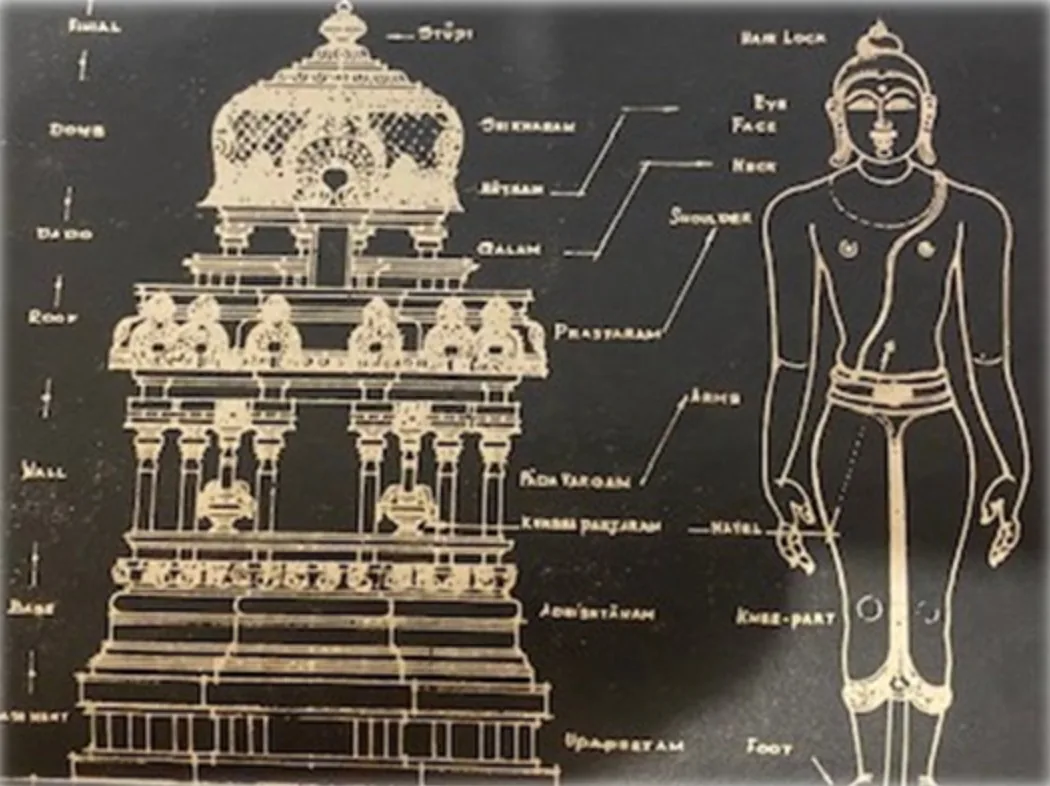
In the Shilpa sastras, the temple itself is equated to a human body either standing up or lying down. The human body is the house and God takes up residence there. In the standing-up model, the shrine/moolasthaanam is interpreted as follows.
The whole structure over the garbhagṛha/moolasthaanam is called Vimaanam. The picture above shows what each part of the Vimaanam relates to in the human body. The shikaram relates to the face, and so it runs from the head down to the feet, which relate to the upapeetam. The space inside the garbhagṛha is known as the brahma-sthaana, which is full of divine vibrations.
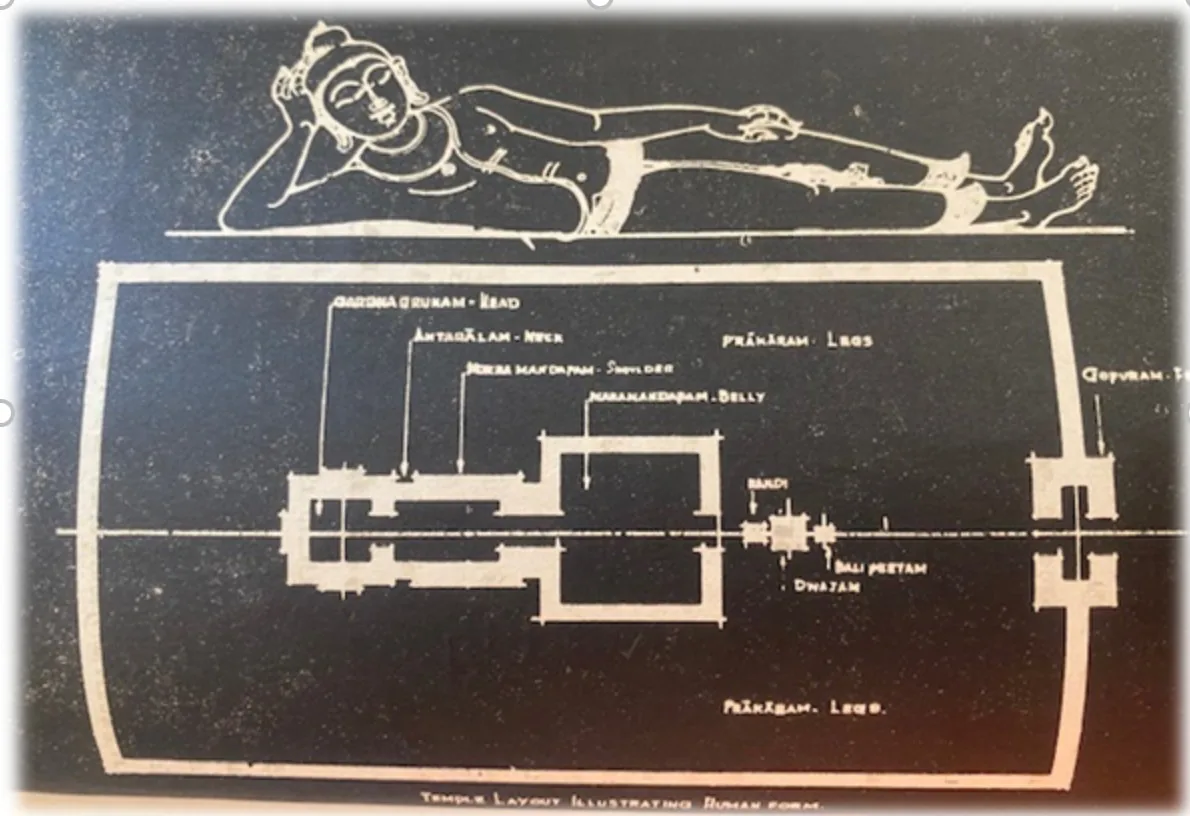
If the temple complex is seen as a person lying down, as shown above, the moolasthaanam is the head, and the structure ends with the feet at the Gopuram, the tower over the entrance.
The south Indian temple is square, as a square is saatvic in nature. It is stated that octagonal temples are of rajasic nature and circular-shaped temples are of tamasic nature.
Building it in Melbourne
In this temple, the moolasthaanam housing the main deity Sri Vakrathunda Vinayagar, as well as seven inner shrines housing Sri Amirthakadeswarar as Sivalingam, Sri Abhirami, Sri Siva Durgai, Sri Murugan with Sri Valli and Sri Deivanai, Sri Sandigeswarar, the Navagrahams, Sri Vairavar and Kodimara Pillaiyar, and outer shrines housing Sri Hanuman and Naagathambiraan, are all transforming into granite.
Twenty artisans, comprising eleven sculptors and eight stucco workers had to be brought from India. Alongside preparing the granite in India, Purushothaman had the added burden of the visa process, from preparing every worker’s biodata to arranging medical examinations and the other formalities for their Australian visas. All artisans were approved and arrived in Melbourne for this wonderful mission. Because of COVID-19, Purushothaman and the artisans had to stay within the temple premises, labouring away. More than 1,000 pieces of cut and carved architectural stone had to be assembled. The Moolasthaanam was constructed with 17 layers, using almost 400 stones. Many of the stones weigh over 400 kg, the largest, at 6 tonnes, being the single-stone shikhara (peak) of the Vimaanam. The inside of the Moolasthaanam has been designed in an unusual hexagonal conical shape which will aid in the amplification of the sound of Mantras inside the Moolasthaanam.
Purushothaman said that Vijayendra Saraswati Swamigal’s choice of date (7 June) had been a blessing: had he chosen August, the work would have slowed down. Instead, Swami’s choice of the earlier date galvanised them into action, so that the workers and the shipments arrived well before the shutdown caused by the virus. He is all-knowing and is guiding us all the way. Now, whatever Sri Vakrathunda Vinayagar wishes will happen. The ambience of the temple is expected to completely change with the transformation into granite. Sri Vakrathunda Vinayagar will decide when he wishes to move out of Baalaalayam and move into his granite abode.
A labour of devotion
Purushothaman is sentimentally attached to the temple he built 28 years ago. In his devotion, he considers this a privilege given by none other than Sri Vakrathunda Vinayagar. As he is confined inside the premises with artisans from India working tirelessly towards completion of the granite transformation, Purushothaman said, “This is not a temple building contract that I am just fulfilling, rather I am blessed to dedicate my knowledge, skill and time at the lotus feet of Sri Vakrathunda Vinayagar.”
In closing, Purushothaman thanked Mr and Mrs Shan Pillai, who brought our eternal Sri Vakrathunda Vinayagar from the Kanchi Mutt to MVHS in 1989, and who have been instrumental in encouraging and supporting every aspect of this divine, historic granite construction in Melbourne.
Purushothaman also thanked the committee members who gave him full support to construct this temple on time, especially the Trustee Mr Sivagnanam, President Mr Balaa Kandiah and Treasurer Mr Sivanathan.
We thank Mrs Mythily Purushothaman and children Dr Sowmiyaa Prabu, Aishwaryaa and Dhinagaran for their encouragement and support, which enabled Purushothaman, who spent nearly two years away from his family, to complete this divine mission.
May Sri Vakrathunda Vinayagar bless us all for a successful Kumbhabhishekam.
Read about the temple’s history, or see the granite shrine in the press and the gallery.