How the Temple Came to Be
From a family home in Templestowe to the first Hindu temple in Victoria
The journey of Sri Vakrathunda Vinayagar coming to Melbourne and making it his home is an interesting one.
This is the story in brief. The full history, from Vinayagam, the book the Sangam published in 2020, is told chapter by chapter: The Arrival, The First Temple, Expansion and Rebuilding, Growth and Financial Freedom and The Granite Temple, with the Miracles of Sri Vakrathunda Vinayagar.
-
August 1989
How it all began
In August 1989 a breakaway group from the Hindu Society of Victoria decided to build a Vinayagar temple. A core team set up the ‘Pro Tem’ Management Committee and, with other like-minded people, began the gigantic task of building the first Vinayagar temple in Victoria.
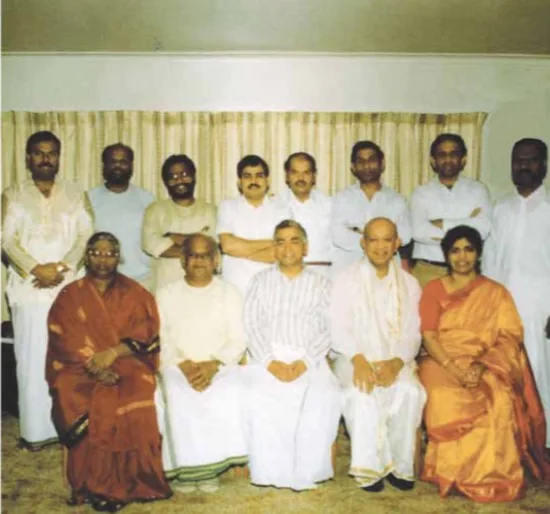
The first ‘Pro Tem’ Management Committee, September 1989 to June 1994. -
September – November 1989
A trip to India: twists and turns
A Vinayagar Vigraham and the implements for poojas were to be bought in India. The Treasurer, Mr Shan Pillai, his wife Parameswary and his mother-in-law Mrs A Subramaniam were going on pilgrimage, and offered to obtain them. In Chennai they ordered two Panchaloga Vigrahams, to be taken to the Kanchi Mutt so that one could be chosen, but on their return the statues were not ready.
Friends suggested they seek the guidance of Jagadguru Sri Sankaracharya Swamigal at Kancheepuram. On 3 November 1989 they met Sri Jayendra Saraswathi Swamigal, who, to their amazement, asked the Kancheepuram Sthapathi to bring the granite Vinayagar he had just completed. Swamigal blessed the statue and gave a letter stating it was for consecration in Australia, which helped greatly in taking it out of India.
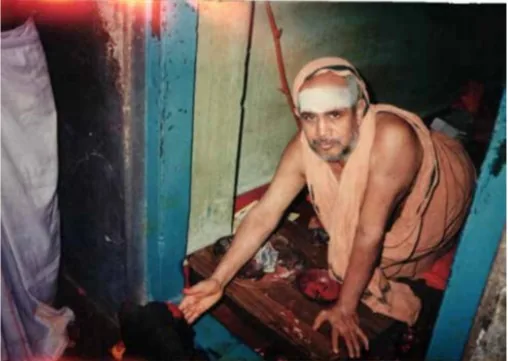
Sri Jayendra Saraswathi Swamigal blessing Sri Vakrathunda Vinayagar. -
November 1989
A second Vinayagar, and the eye-opening in Singapore
Back in Chennai, the two Panchaloga statues had arrived. At 4 am the next day they were taken to Kancheepuram, where Sri Chandrasekara Saraswathi Swamigal of the Kanchi Mutt chose one after much thought: today's single-faced Utsava Moorthy.
On the way home the statues stayed at Sri Senpaga Vinayagar Temple in Singapore, where the famous Visvanatha Kurukkal and a local Sthapathi performed the ‘eye-opening’ ceremony.
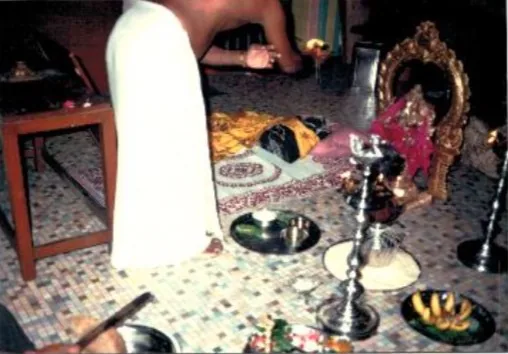
The eye-opening ceremony at Sri Senpaga Vinayagar Temple, Singapore. -
November 1989
Sri Vakrathunda Vinayagar arrives in Melbourne
The granite and Panchaloga Vinayagars came to Melbourne in two wooden boxes and were housed at 386 Porter Street, Templestowe, the newly bought home of Mr Nirmalan Pillai and his family. Mr Sabapathy Somasundaram, a ‘Pro Tem’ committee member, performed the daily early-morning abhishekams and prayers. The Moola Moorthy stayed in the house until the temple was built.
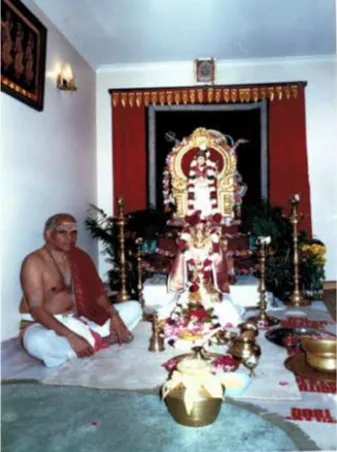
Sri Vakrathunda Vinayagar at 386 Porter Street, Templestowe. -
1 January 1990
The first gathering of devotees
More than 500 devotees gathered at Camberwell School Hall to celebrate the New Year, and the very first Sangabhishegam to the Utsava Moorthy was performed. A lottery among those who had promised to become Life Members ($5,000) chose a Trustee of the temple: Dr J Maheswaran.
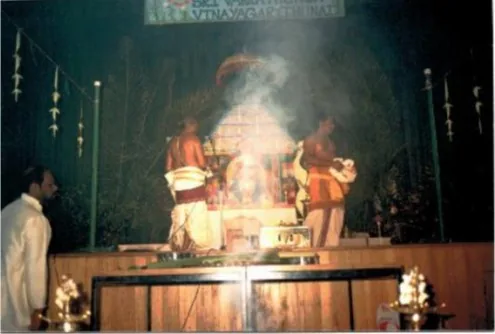
The first Sangabhishegam at Camberwell School Hall, 1 January 1990. -
29 May 1990
The Melbourne Vinayagar Hindu Sangam is born
Mr Sivagnanam lodged the application to register the Melbourne Vinayagar Hindu Sangam on 7 March 1990, and registration came through on 29 May 1990, with the goal of building a temple for Sri Vakrathunda Vinayagar.
A ‘Pro Tem’ Pooja Committee scheduled the poojas, and a newsletter, Saiva Neri, kept devotees informed. Until the first consecration, poojas and festivals were performed by Sri Gnanasegara Kurukkal, Sri Vijayan Sarma and Sri Arumuga Iyer. Members and their families looked after everything else, with Mrs P Somasundaram making sure every festival was prepared in a timely and auspicious way. Mr Varatharajalingam drove far out to buy flowers from the farm and brought them to 255 Porter Street, Templestowe, where the priest and well-wishers prepared for each event. Every hall was swept and mopped before the deity was brought in, mostly by Mrs P Senthuran, Mrs Parameswary Pillai and Mrs Rani Thuraisingam. Mr Thanabalasingam or Mr Kumarakuruparan carried the deity, with Mr Canagalingam in his van, and Mrs A Maheswaran, Mrs P Shanmuganathan and Mrs S Balendran took turns cooking the prasadam.
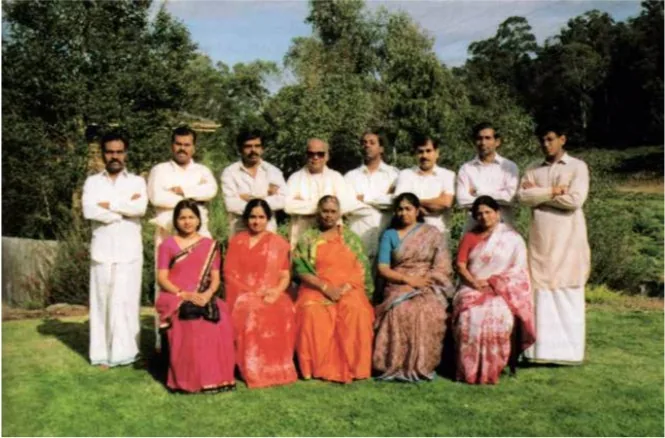
The first Pooja Committee, September 1989 to June 1994. -
20 April 1990
A home in The Basin
Five pioneers who later became Trustees, Mr Nirmalan Pillai, Dr S Selvendra, Dr R Rajendra, Mr V Canagalingam and Mr S Somasundaram, each pledged $20,000, and more than $300,000 was pledged before a site was even found. Some members took personal loans of $10,000 to lend the temple, and Mr Nirmalan Pillai mortgaged his house so the bank would lend the rest.
On 20 April 1990 the Sangam bought land in The Basin, the former site of St Mary's Anglican Church. A Building Committee led by Mr M Maheswaran prepared the plans and applied to the City of Knox.
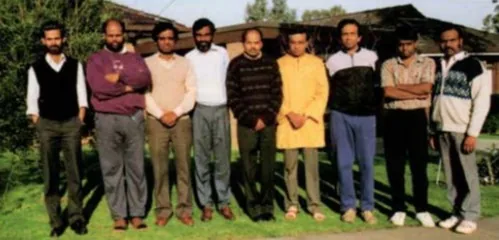
The first Building Committee. -
November 1991
Laying the foundation
The foundation stones were laid in November 1991 before a large crowd, and the building permit was approved in December 1991.
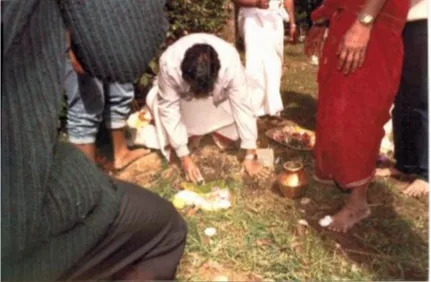
Sangus (conches) being planted before the foundation stone ceremony. -
1992
Building works in full swing
In February 1992 the temple architect (Sthapathi) Mr J Purushothaman arrived from India with five artists from Mahabalipuram to begin building. On 21 February 1992 a group of devotees bought the house behind the temple, 2 Conyers Street, later selling it to the Sangam at cost. It now houses the Chief Priest.
-
11 October 1992
The first Hindu temple consecrated in Victoria
Thousands of devotees came to the consecration, with Somaskantha Kurukkal presiding. Every traditional ceremony was performed, including the ‘Ennai Sathuthal’ (oiling of the deities), followed by 41 days of Mandalabhishegam.
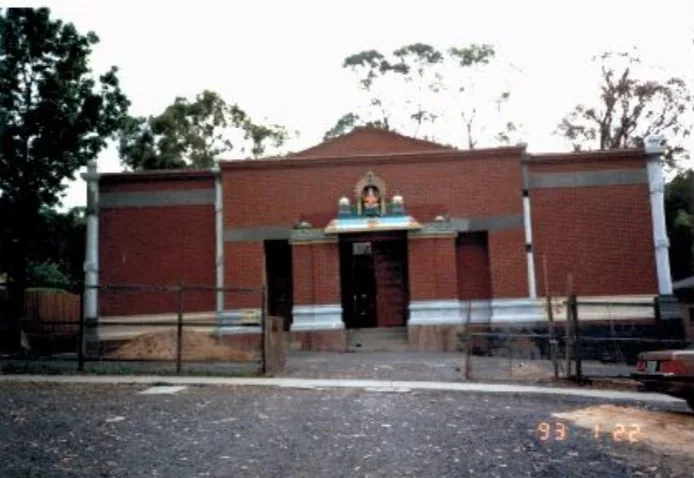
The completed temple in 1993. 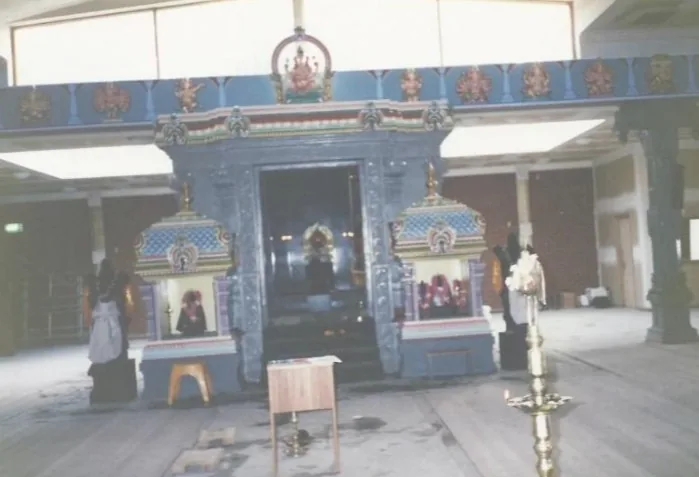
The interior of the temple in 1993. -
1993 – 1999
Fundraising and growth
In 1993 the Sangam raffled a piece of land, selling 1,473 tickets at $100 and raising a net $97,000. Mr Thanabalasingam applied to the Raffle Board for this unusual raffle, and Mr T Sivanathan and Mr S Somasundaram were critical to its success, persuading many of their relatives to buy tickets.
Annual vegetarian dinners, and Friday ‘Dosa nights’ led by Mr and Mrs Sriharan before the kitchen was built, all went to the building fund. So did full temple weddings, from decorating the Manavarai to cooking the feast: Mr Varatharajalingam and Mr K Thuraisingam made a full garland Manavarai with the help of many of the ladies. Dr Chandrabhanu of the Chandrabhanu Bharatalaya Academy organised a fundraising performance with Ambika and Mr Balasri, and in 1996 a concert by Shoba Shekar and Jayshree Ramachandran raised about $3,000. Members have also helped with the Salvation Army's annual appeal since the Sangam began, first led by Dr N Shanmuganathan and later by Mr N Balasubramaniam.
In 1995 the house next door, 1290 Mountain Highway, was bought for the temple manager; Mr Sivasamy served as manager and caretaker for more than 13 years. The temple kitchen was approved in 1997 and built soon after. In 1999 a fire in the front of the hall was quickly brought under control, and a Mahashanti was performed.
-
2000 – 2006
Years of rebuilding
From 2000 to 2004 the Sangam was involved in a court case with some of its members, resolved by a court-mandated settlement. The community was slowly brought back together. In 2004 the Panchamuga Vinayagar was brought and consecrated, and on 5 December 2005 the house behind the kitchen, 4 Conyers Street, was bought.
The first Youth Committee organised Kshipra, a talent quest at Robert Blackwood Hall on 13 May 2006, raising more than $8,400. From 2004 to 2009, Mr Ramachandran was one of the people who kept the temple and its kitchen running to plan, and the temple moved from paper receipt books to computerised receipts.
-
17 June 2007
Punarvathana Maha Kumbhabhishegam
The renovated temple was reconsecrated with a three-storey granite Rajagopuram, a Kodisthambam, new shrines for Siva, Siva Durga and Murugan, and new niche deities including Nagathambiran and Hanuman, who had until then stood in a shed by the tree next to the temple. The Moolasthanam's glass panels and ceiling were replaced, the Vasantha Mandapam was extended to include Murugan, Valli and Devayani, and the wall of 16 Vinayagars and the Ashta Lakshmis was newly decorated. The Building Committee was led by Mr Kanakeswaran with Mr VCS Raghavan.
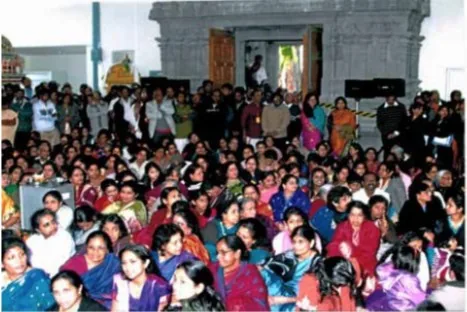
The crowd gathered for the 2007 Kumbhabhishegam. -
18 – 28 April 2008
The first Mahotsavam in Victoria
Under Gowrieswara Kurukkal, the temple held the first annual Mahotsavam in Victoria. Mr Thanabalasingam won the Council's permission to take the Thaer (chariot) out on the street, and it is now part of the Council's cultural calendar. This is still the only temple that takes its Thaer through the streets of Melbourne.
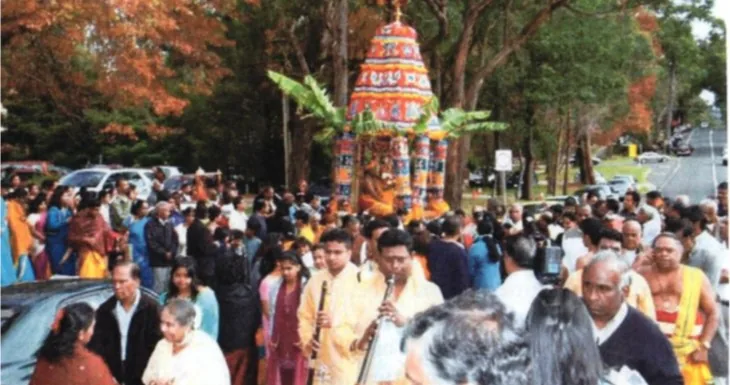
The first Mahotsavam, 2008. -
2010 – 9 June 2013
Melbourne Vinayagar Cultural Hall
Begun in 2010 and built next to the kitchen with $250,000 in government grants, the multi-purpose hall was opened on 9 June 2013 by the Hon David Hodgett, Minister for Ports and Major Projects. All the temple's properties were consolidated into one title, and a Balasthabanam for Nagathambiran and Hanuman allowed a roof to be built over their shrines. In 2010, Mr Yogan Kandasamy organised Isaai Payanam, a concert by playback singers from India, for the temple building fund.
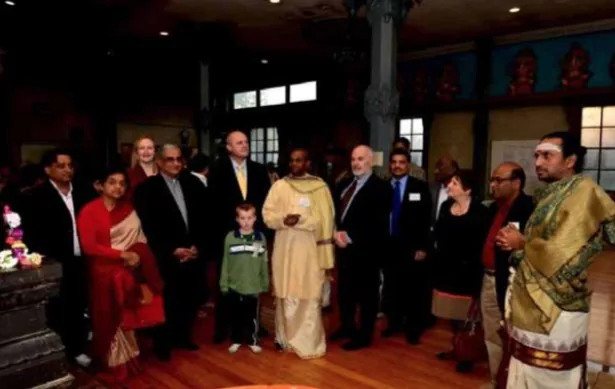
Dignitaries visiting the temple before the hall opening. -
27 April 2013
A new Thaer
A new Thaer was bought from Sri Lanka and assembled in Melbourne, with its Vellottam on 27 April 2013. A Thaer shed, an exhaust system for the lamp soot, and the rear car park followed.
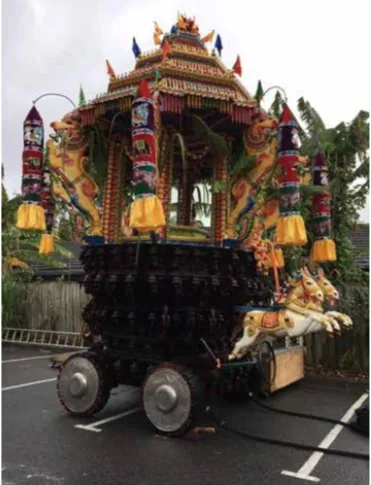
The new Thaer in 2013. -
2015 – 2017
Twenty-five years, and debt-free
The Sangam amended its constitution for only the second time, hosted a Natheswara Katchery with musicians from India and Melbourne in 2016, and the temple became completely debt-free.
-
Today
Thousands of devotees, and a new Community Hub
During major festivals thousands of devotees gather to receive the blessings of Sri Vakrathunda Vinayagar. What began as a dream of a few families has become a reality thanks to everyone who contributed in one way or another, and the MVHS Community Hub is now being built for the next generation.
The unseen pillars
No history of the temple is complete without the people who have worked tirelessly for it: N Balasubramaniam, who managed the car park at every major function and worked with the Council to move power lines for the Thaer; Ds Manogaran, for maintenance at any hour and as ‘Parthasarathi’ of the Thaer; B Jeeva, the temple's handyman; K Thuraisingam, for the decorations at every major function; S Meera, for the annual calendar; G Moganaraju and J Rasaratnam; Vasanthi Mohan, Anietha Mohan and Hari Mano, for the Amman sarees; and Raj and Rani Nagarajan, for running the canteen.
And the garland makers, the canteen volunteers and the monthly cleaning volunteers, to name a few.